Mark Side Up Get the Book · $29

The companion guide to the Roy Danforth – Antiques Hunter channel

Read the mark before anything leaves the house.

Mark Side Up: The Inherited Jewelry Box is an order of work for a parent's jewelry box. Read the stamp, find the signature, check the clasp and the stone, and see what pieces like yours actually sold for. Then decide.

$29 Digital PDF · 307 pages · 14 chapters · prices checked October 2026

Get the Book · $29

Digital PDF, delivered by email, nothing is shipped. 30-day refund.

Host of the Roy Danforth – Antiques Hunter channel holding the book and the Sorting Kit
Illustration. The host of the Roy Danforth – Antiques Hunter channel is an AI-generated character. The book is written and checked by a small editorial team from the published sources it cites.

What you get for $29

One PDF you can read on a tablet or print at home, in large type with color diagrams of backs, stamps and clasps. It is organized by what you do at the table, in order, from the first hour with the box to the day the estate sale company arrives.

Every chapter opens with what it decides and a one-minute check you do with the piece in your hand. Every price in it carries its venue and its date. And every chapter tells you what is not worth much before it tells you what might be.

This book is not an appraisal and its authors are not appraisers. It helps you decide which pieces deserve one.

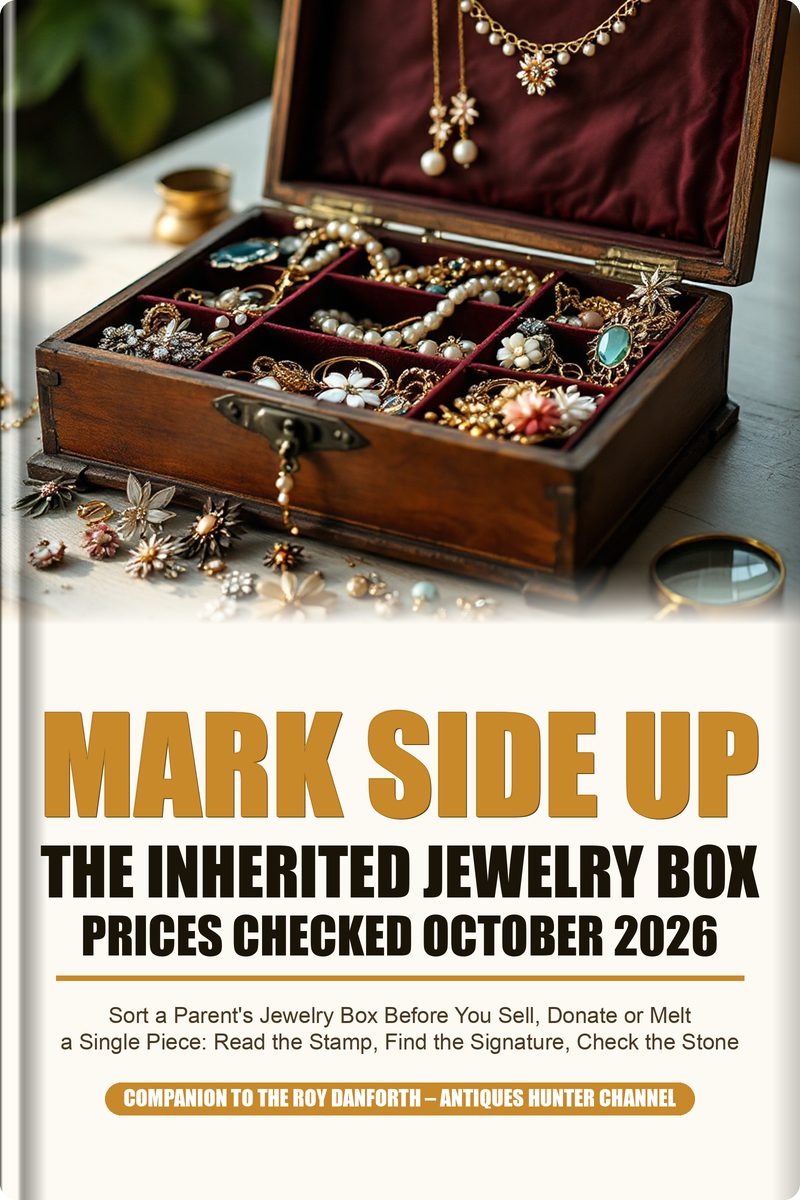
Cover of Mark Side Up: The Inherited Jewelry Box

Mark Side Up: The Inherited Jewelry Box

Digital PDF · 307 pages · 14 chapters, three appendices and an index · prices and fees checked October 2026

$29

One payment for the book. No subscription.

Get the Book · $29
  • Secure checkout by Stripe
  • Download page right after payment, and a copy of the link by email
  • Digital PDF, delivered by email, nothing is shipped
  • The Kitchen Table Guarantee: 30-day refund, no questions
  • Prices and fees checked October 2026, with the date printed on the cover
  • Every price line names the piece, where it sold, when, and what it brought
  • Every chapter ends with a Check me list: the sources, their dates, where to read them

From the makers of the Roy Danforth – Antiques Hunter channel on YouTube. The channel's host is an AI-generated character; nothing in the book is credited to his experience.

Sound familiar?

The box is open on the kitchen table, and there is a date on the calendar.

Nobody teaches you where to look. That is the problem this book was written for, and it takes it one piece at a time.

01 · The stamp says 14K

A ring says 14K, a bracelet says 925, and a pendant says nothing at all.

A stamp is what someone put on the metal. It is a starting point, not proof. You learn what each number means, why a maker's mark should sit beside a karat stamp, and when a stamp needs a second look.

Chapter 2: Read the Stamp: Karat, Sterling and the Numbers

02 · The chain that says 12K

Heavy, gold-colored, and stamped 1/20 12K GF.

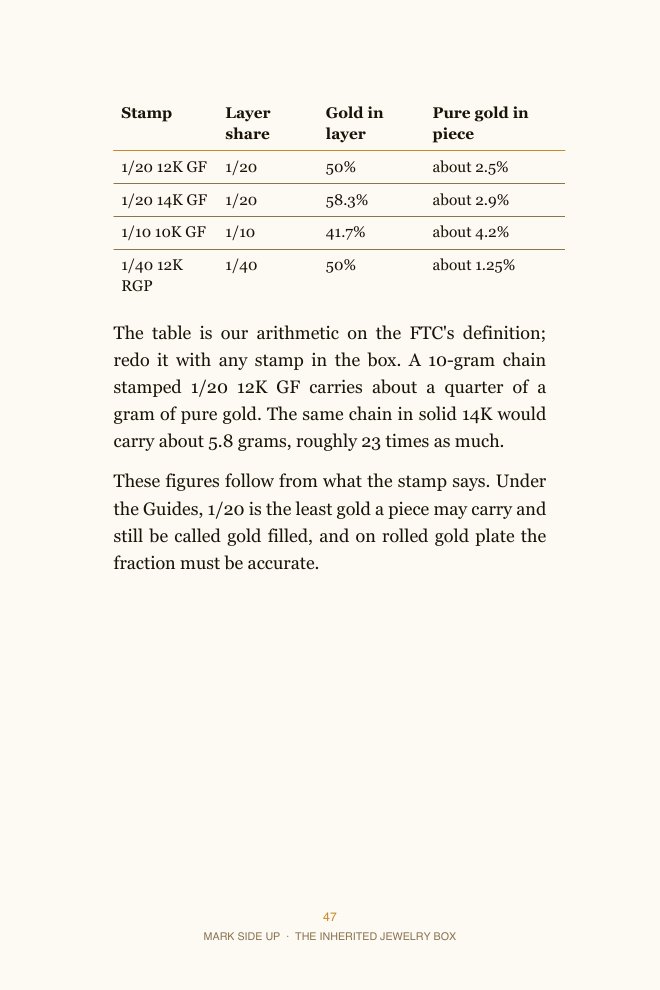
Those letters are the ones that tell you how little gold there is. By the arithmetic on the FTC's own definition of gold filled, that chain is about 2.5 percent gold by weight. A 10-gram chain carries about a quarter of a gram. It goes in the Sell or Donate pile, not the melt pile.

Chapter 3: The Stamps That Only Look Like Gold

03 · Too much, too fast

Three boxes, a drawer, and an estate sale company coming on Saturday.

The first hour decides more than the next ten. What goes in a hold tray, untouched. Then five piles, with Not sure yet as the default, so nobody has to decide everything this weekend.

Chapter 1: Before Anything Leaves the House

04 · The number online

You looked up a brooch like your mother's and found a price that made you stop.

That was a listing. A listing is a hope. You learn how to find what pieces like yours sold for, how to read a result with or without the buyer's premium, and how to write your own dated price line.

Chapter 9: Sold, Not Asked: What It's Really Worth

05 · The counter with the scale

A buyer will weigh it and make you an offer. You have no number of your own.

You will, before you drive anywhere. One pile per karat, weighed at home, and one line of arithmetic with the day's spot price. Above the formula sits one rule: a piece worth more as a piece is never melted.

Chapter 10: The Gold Buyer's Math

06 · The bag for the thrift store

No gold, no silver, so it must be junk.

Costume pieces can carry a maker's name on the clasp, the back plate or an earring clip. And a piece with no name is not automatically worthless. You learn which signed and unsigned pieces stay out of the donation bag.

Chapter 5: Signatures Worth Turning Over

We never promise a payday. The book is built so that nothing good leaves the house by mistake.

Start With the First Hour · $29

How the book works

Three checks, five piles, and one rule for every price.

If you watch the channel, you have seen the gesture: turn it over. The book turns that gesture into an order of work you can repeat with every piece in the box.

Stamp, Clasp & Stone

Stamp: the karat or silver mark, and the maker's mark beside it. Clasp: where many makers sign, and where a magnet misleads, because a spring-ring clasp holds a steel spring. Stone: the setting and the back of the stone before the stone itself. Most checks need only good light and a 10x loupe, a folding jeweler's magnifier.

Five piles

  • Appraise
  • Sell
  • Keep
  • Donate
  • Not sure yet

Every piece ends up in one of them. Keep means what the family wants, at any value. Not sure yet is the default, and it is allowed to stay full for a while.

Sold, not asked

A price is what something sold for, not what someone asked. Every price line in the book reads the same way:

The piece · where it sold · when · what it brought · Verified, Sourced or Contested

A sale from a famous owner is marked "not typical", and where sources disagree, the book prints both and says which way it leans.

When it's not worth much

In every chapter, a paragraph with that heading comes before any good-news price: the common version, the condition problem, the look-alike. Metal gets a formula instead of a price table, because gold and silver move every day.

A wooden jewelry box open on a kitchen table, with chains laid out on a cloth beside a cardboard box
Illustration.

Get the Book · $29

The full table of contents

14 chapters, in the order you work at the table.

Nothing hidden. This is the contents page of the book, chapter by chapter.

  1. Chapter 1

    Before Anything Leaves the House

    What goes in a hold tray, untouched, and how the rest divides into five piles.

  2. Chapter 2

    Read the Stamp: Karat, Sterling and the Numbers

    What each gold, silver and platinum stamp says, and when it needs a second look.

  3. Chapter 3

    The Stamps That Only Look Like Gold

    Which gold-colored pieces carry only a layer of gold, and what to do with an unstamped chain.

  4. Chapter 4

    The One-Minute Checks, and the Tests That Lie

    Which home checks are safe, which tests to stop using, and when to pay for an XRF reading, a metal test that does no damage.

  5. Chapter 5

    Signatures Worth Turning Over

    Which signed pieces stay out of the donation bag, and how to date one by its ©, patent number or mark.

  6. Chapter 6

    Unsigned, 'In the Style Of', and Signed Fakes

    Which unsigned pieces deserve a second look, and how to label a piece you believe a maker made.

  7. Chapter 7

    Stones, Glass and Pearls

    Which stones and pearls earn a gemologist's look, and which are glass or imitation.

  8. Chapter 8

    Silver With a Name, Bakelite, and the Materials You Can't Sell

    Which silver stays out of the melt pile, how to check Bakelite without damage, and why ivory and tortoiseshell stay off any sale list until you have checked federal and state rules.

  9. Chapter 9

    Sold, Not Asked: What It's Really Worth

    Whether a price you found is a closed sale, and how to write your own dated price line.

  10. Chapter 10

    The Gold Buyer's Math

    Which pieces can be sold for metal, and your melt number for each karat before you hear an offer.

  11. Chapter 11

    When an Appraisal Is Worth Paying For

    Which few pieces earn a written appraisal, whom to ask, and how the fee should be set.

  12. Chapter 12

    Which Pile Goes Where

    Which buyer or venue fits each pile, and what each one keeps where a fee is published.

  13. Chapter 13

    Don't Clean the Value Off It

    What can be washed, what stays as you found it, and how to store everything while the family decides.

  14. Chapter 14

    The Rest of the House, Briefly

    Which flatware, watches, cufflinks and kitchen glass to pull aside before the house is priced.

After the chapters
  • Appendix A: Print-Ready Cards. The stamp card, the five piles, the one-minute checks, the melt formula and the questions to ask a gold buyer or an appraiser.
  • Appendix B: Makers at a Glance. Every maker and silversmith named in Chapters 5, 6 and 8, with the marks and dates collectors give where a source exists.
  • Appendix C: Check Me, and What We Could Not Verify. Every source and where to find it, then what we could not confirm.
  • Index. The words you are likely to look up, such as 585, GF, buyer's premium and pennyweight.

Get All 14 Chapters · $29

Look inside before you buy

Three pages from the book, as they are.

Tap a page to open it full size.

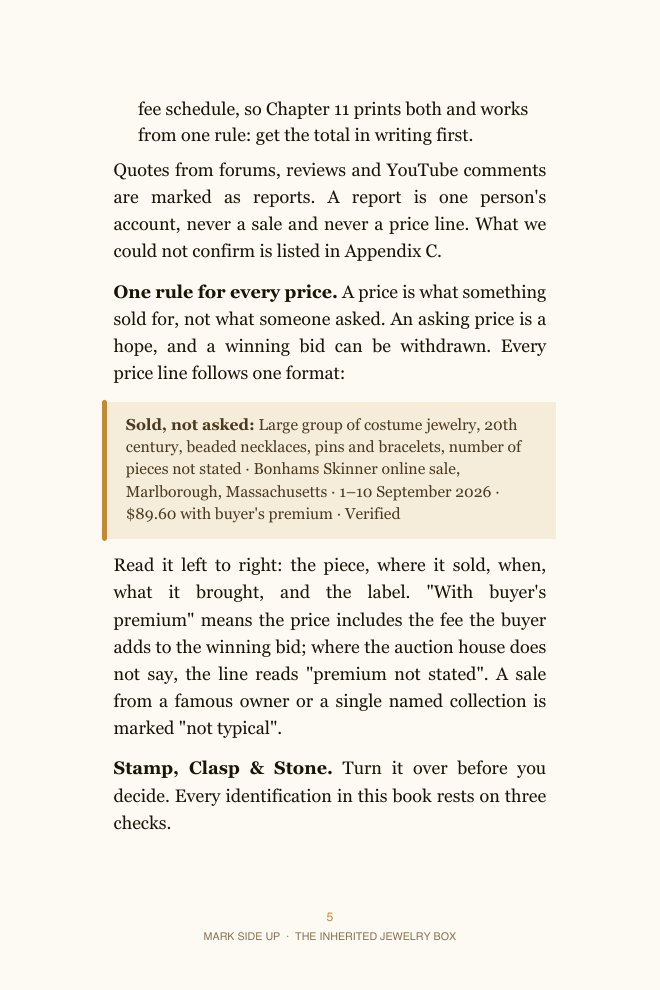
Interior page from the front matter showing a Sold, not asked price line and the Stamp, Clasp and Stone checks
From "How to read this book": how a price line reads, and the three checks behind every identification.
Interior page from Chapter 3 with a table of gold filled stamps and the gold content of each
From Chapter 3: the arithmetic behind 1/20 12K GF, stamp by stamp.
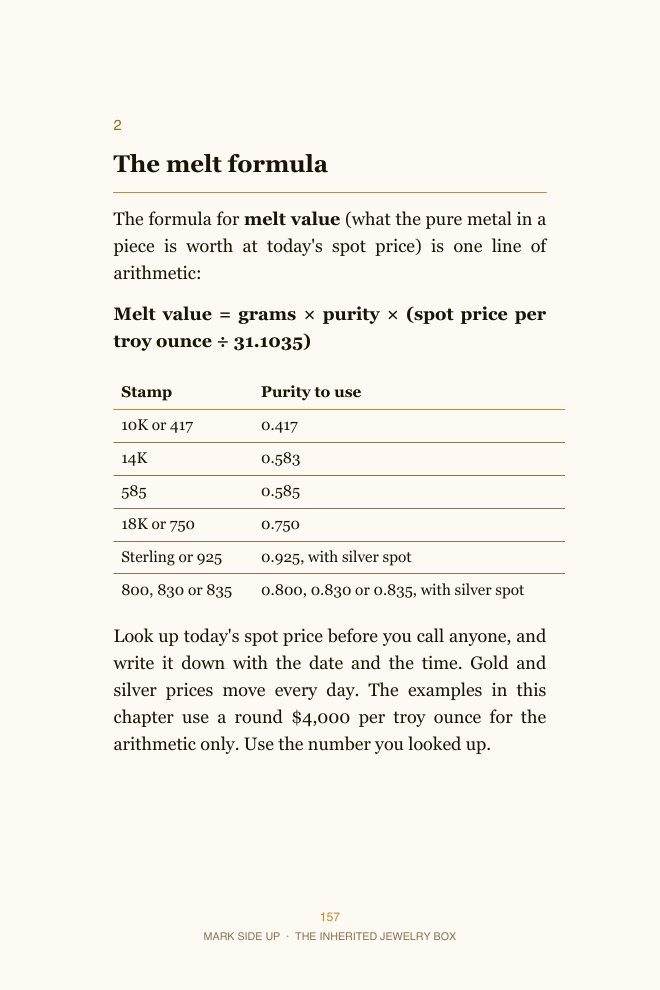
Interior page from Chapter 10 with the melt formula and the purity to use for each stamp
From Chapter 10: the melt formula, and the purity to use for each stamp.

Get the Book · $29

Cover of The Mark Side Up Sorting Kit

Optional · $12

The Mark Side Up Sorting Kit

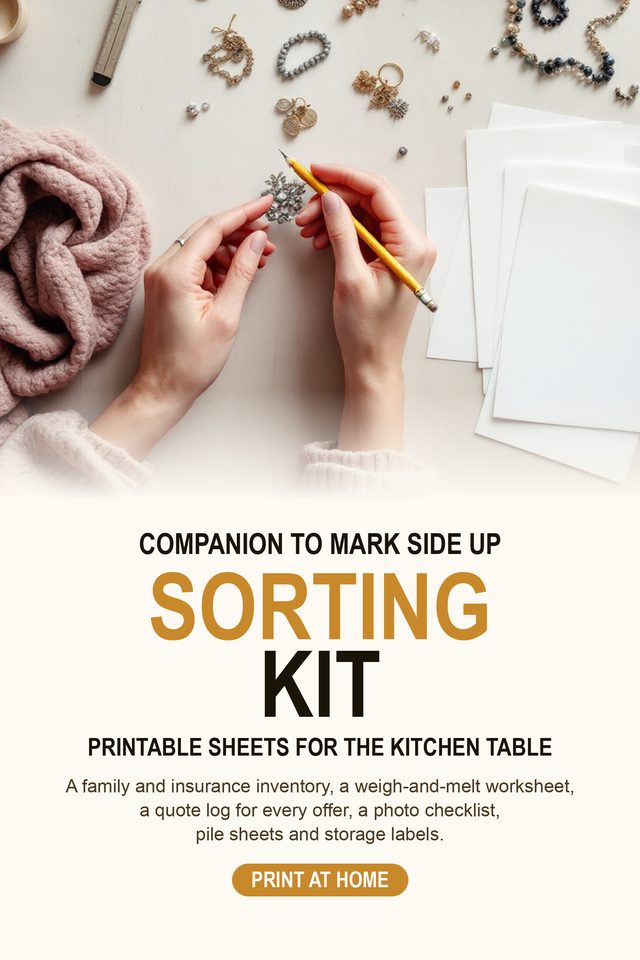
The book tells you what to decide. The kit is where you write it down, piece by piece, so the family, the insurer and the buyer all read the same list. It adds no new teaching. The Sorting Kit is a printable PDF of 21 pages for US Letter paper, with ten sheets:

  • The Three-Week Plan: the book's order of work, one day per row, from the first Saturday to the estate sale
  • Family and Insurance Inventory Log
  • Distribution Receipt, for each time a piece changes hands
  • Family Receipt: the whole division on one page, signed by every heir
  • Running Total per Heir
  • Weigh-and-Melt Worksheet, one line per karat, with a blank for the day's spot price and its date
  • Quote Log, to compare every offer side by side
  • Photo Checklist, for anything worth listing or appraising
  • Pile Sheets
  • Envelope Labels

To add it, tick the box in the price box before you pay. The book and the kit then come in one payment of $41.

Go to the price box

What it costs

One price for the whole book.

Mark Side Up: The Inherited Jewelry Box307 pages · 14 chapters · three appendices and an index$29
The Mark Side Up Sorting KitOptional · ten printable sheets+ $12
Both, in one payment$41

A written appraisal of a single piece typically runs $120 to $250. This book helps you decide which pieces deserve one.

Most of an inherited box needs no appraisal at all. Chapter 11 shows which few pieces do, whom to ask, and how the fee should be set, so you pay for an appraisal only where one is worth paying for.

Get the Book · $29

Who it is for

Written for the person who inherits the box.

It is for you if

  • you are emptying a parent's house, or your own, and the jewelry is still in the box
  • an estate sale, a move or a family meeting has a date on it
  • you would rather check a piece than guess
  • you want to know what is not worth much as plainly as what is

It is not for you if

  • you need a dollar value for one specific piece today: that is an appraisal, and Chapter 11 tells you how to get a good one
  • you collect and want a maker encyclopedia; Appendix B is a quick reference, not a catalog
  • you are looking for a promise of money; this book makes none
30
days

The Kitchen Table Guarantee

Read it with the box open. If it does not change what goes in which pile, write to mysteriesmediallc@gmail.com within 30 days of your purchase and you get every cent back. No questions, no forms, and you keep the PDF.

Try It for 30 Days · $29

Questions

Before you decide

Is this a printed book?

No. It is a digital PDF of 307 pages, delivered by email; nothing is shipped. Right after payment you land on your download page, and the same link arrives in your inbox. Read it on a tablet or a computer, or print the chapters you need at home. The type is large and the diagrams are in color.

I already watch the channel. Why buy the book?

The channel is free and will stay free. Keep watching it. A video shows one kind of piece at a time; the book is the complete order of work, from the first hour with the box to the estate sale, with the sources for every fact and the date on every price. It sits open on the table while you sort, and each chapter ends with a Check me list so you can verify what it says.

Is the host a real person?

No. Roy Danforth, the host of the Roy Danforth – Antiques Hunter channel, is an AI-generated character. The book is written and checked by a small editorial team from published sources, and those sources are cited in every chapter with their dates. Nothing in the book is signed by the host, quoted from him or credited to his experience, and it contains no personal sales records or first-hand anecdotes.

Will it tell me what my pieces are worth?

This book is not an appraisal and its authors are not appraisers. Prices shown are past sales with their venue and date; what your piece brings depends on its condition, the market and the day. For an estate, insurance, a donation or dividing pieces among family, get a written appraisal from a credentialed appraiser (ASA, AAA or ISA) before anything valuable changes hands.

What the book does give you is the method: how to find closed sales for pieces like yours, how to write a dated price line, your melt number for each karat, and which few pieces earn a written appraisal.

My mother's box is mostly costume jewelry. Is it still worth reading?

That is the box this book expects. Chapters 5 and 6 cover signed and unsigned costume pieces, Chapter 7 covers glass, stones and pearls, and Chapter 13 covers what never to wash. Each chapter also says plainly what is not worth much, so the Donate pile can go out the door without second thoughts.

How current are the prices?

Prices and fees were checked in October 2026, and that date is on the cover. Every sale in the book carries its venue and its date, so you can see the age of a number at a glance. Gold and silver move every day, so the book gives you the melt formula and has you look up the day's spot price instead of printing a metal price table.

Do I need the Sorting Kit?

No. The book works on its own, and Appendix A already holds print-ready cards for the stamps, the five piles, the one-minute checks and the melt formula. The kit is for writing things down: the family and insurance inventory, the weigh-and-melt worksheet, the quote log and the rest. If you are dividing pieces among family or getting quotes from buyers, it saves you drawing the tables yourself. It is $12, added with one tick at checkout.

What if it is not for me?

Write to mysteriesmediallc@gmail.com within 30 days of your purchase and you get a full refund. No questions, no forms, and you keep the PDF.

Get the Book · $29

Cover of the free Mark Side Up Stamp Card

Free · printable

Not ready for the book? Start with the Stamp Card.

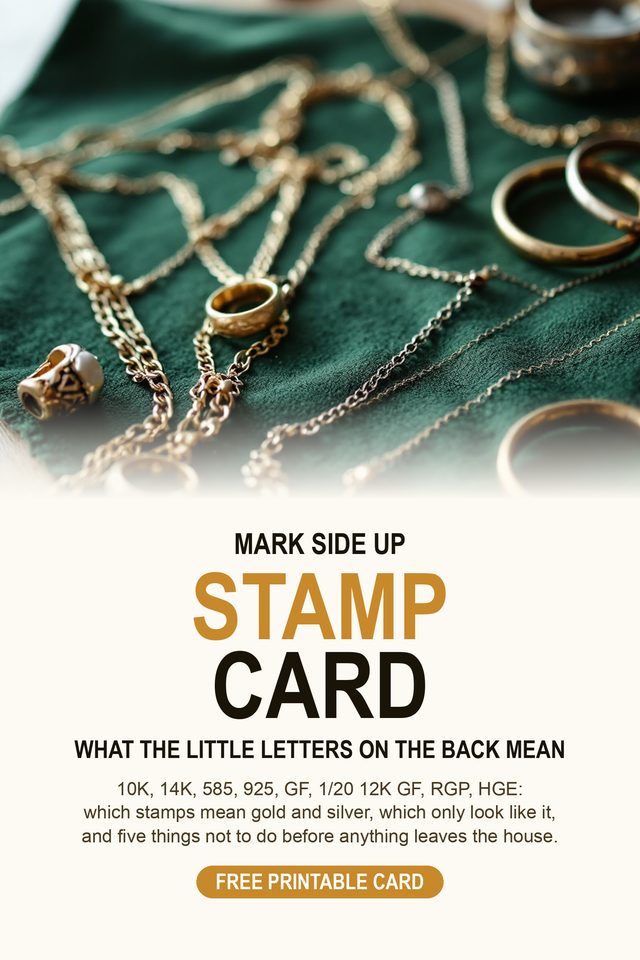
A free printable PDF in two parts, for the kitchen table. The Stamp Card reads the little letters on the back: the common gold and silver stamps, what each one means in plain words, and which pile it sends the piece to. Not Yet lists five things not to do this week.

It covers only what is stamped. No stamp at all, a name instead of a karat mark, a stone, a price: that is what the book is for.

One email with the card, then three short emails over the next nine days with what the card cannot tell you. Unsubscribe from any of them in one click. See our privacy policy.

Before the estate sale. Before the donation bag. Before the counter with the scale.

Turn it over before you decide. The book gives you the order to do it in, the checks to run, and the numbers to bring with you.

  • Mark Side Up: The Inherited Jewelry Box, 307 pages, 14 chapters
  • Prices and fees checked October 2026, every sale with its venue and date
  • Digital PDF, delivered by email, nothing is shipped
  • The Sorting Kit if you want it, $12 at checkout
  • The Kitchen Table Guarantee: 30-day refund, no questions

Get the Book · $29

Secure checkout by Stripe · Questions: mysteriesmediallc@gmail.com